
 EN
EN



In modern power systems, voltage transients and lightning-induced surges pose a serious and often underestimated threat to inverters, solar panels, control units, and other sensitive electronic equipment. A surge protection device is the first and most critical line of defense against these destructive energy spikes, limiting overvoltage before it can penetrate downstream equipment. Understanding exactly how a surge protection device performs this protective function is essential for engineers, system integrators, and facility managers who are responsible for long-term equipment reliability.
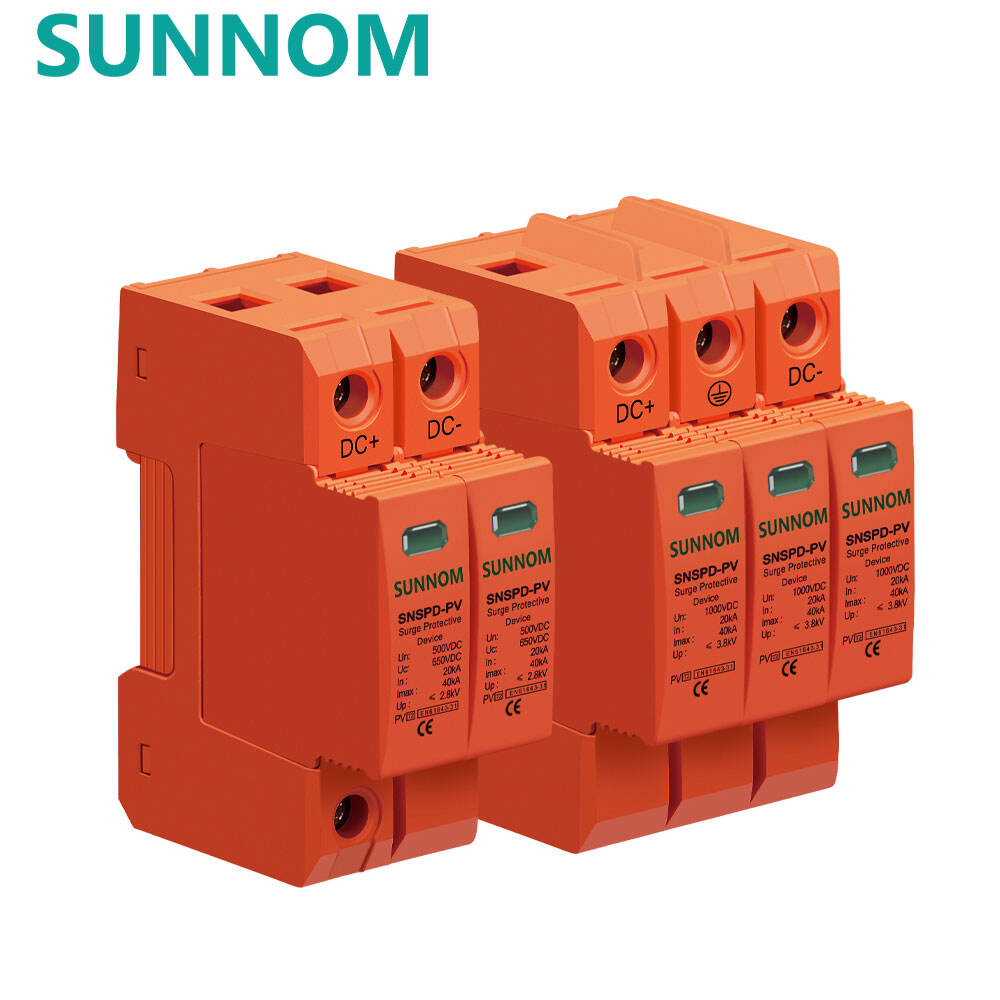
Whether deployed in a rooftop solar installation, an industrial control cabinet, or a commercial building's electrical infrastructure, the surge protection device operates through a precise set of physical and electrical mechanisms. These mechanisms detect, divert, and clamp transient voltages within microseconds, preserving the integrity of inverters and every piece of sensitive electronics connected to the circuit. This article explains exactly how those mechanisms work, why they matter, and what makes a surge protection device an indispensable component in any robust power protection strategy.
The Core Mechanism Behind a Surge Protection Device
How Transient Voltage Events Are Generated
Transient voltages, commonly called surges or spikes, are sudden, short-duration increases in electrical voltage that far exceed the normal operating level of a circuit. They can originate from external sources such as direct or indirect lightning strikes, or from internal sources such as the switching of large inductive loads, capacitor bank operations, and grid faults. In photovoltaic systems specifically, the long cable runs between solar arrays and inverters create ideal conditions for induced surge energy to travel directly into sensitive components.
When a lightning strike occurs even at a significant distance from an installation, the electromagnetic pulse it generates can induce high-voltage transients on both AC and DC conductors. These transients can reach several thousand volts in milliseconds, far exceeding the withstand voltage ratings of modern inverters and control electronics. Without a surge protection device in place, this energy travels unimpeded into the equipment, causing immediate catastrophic failure or, more insidiously, cumulative degradation that shortens equipment lifespan without obvious symptoms.
Internal switching transients are equally dangerous. Variable frequency drives, contactors, and transformer switching all generate voltage spikes that propagate through the electrical system. A surge protection device installed at critical nodes in the circuit intercepts these spikes before they can affect sensitive downstream equipment, making surge protection relevant not only for outdoor or lightning-prone environments but for any industrial or commercial electrical installation.
The Clamping and Diversion Process Explained
At the heart of every surge protection device is a set of voltage-clamping components, most commonly metal oxide varistors (MOVs), transient voltage suppression diodes, or spark gap technologies. Under normal operating conditions, these components present a very high impedance and effectively remain invisible to the circuit. The moment a transient voltage exceeds the device's clamping voltage threshold, the components rapidly switch to a low-impedance state and redirect the excess energy away from the protected equipment.
This diversion pathway leads the surge energy to the earthing system, where it is safely dissipated. The transition from high impedance to low impedance happens in nanoseconds to microseconds, which is fast enough to protect even the most sensitive microprocessor-based equipment. The residual voltage that reaches the downstream equipment after clamping is known as the protection level voltage, and a well-designed surge protection device keeps this value well below the impulse withstand voltage of the equipment it is protecting.
MOV-based surge protection devices are widely used because they offer excellent energy absorption capacity across a broad range of surge amplitudes. They are particularly suited to DC applications such as solar PV systems, where the surge protection device must handle continuous DC voltage while remaining ready to clamp transient spikes at any moment. The combination of fast response time and high energy capacity makes this technology reliable in both high-frequency switching environments and rare but severe lightning events.
How a Surge Protection Device Protects Inverters Specifically
Vulnerability of Inverters to Voltage Transients
Inverters are among the most voltage-sensitive components in any renewable energy or industrial power system. They contain insulated gate bipolar transistors (IGBTs), capacitors, gate drivers, and control boards, all of which have precise voltage tolerances. Even a transient event lasting only a few microseconds and exceeding the component's rated withstand voltage can permanently damage the gate oxide layer of an IGBT or cause capacitor dielectric breakdown.
In a solar PV installation, the inverter sits at the intersection of the DC string circuits and the AC output network, making it exposed to transients from both sides simultaneously. On the DC side, lightning-induced surges travel along array cables. On the AC side, grid switching events and neighboring equipment can inject transients through the output terminals. A surge protection device installed on both the DC input and the AC output of the inverter creates a protective envelope that dramatically reduces the risk of transient-related inverter failure.
Field data from solar installations consistently shows that inverters operating without adequate surge protection experience significantly higher failure rates, particularly in regions with high lightning ground flash density. Replacing a failed inverter is not only costly in terms of the unit itself but also involves lost generation revenue, labor costs, and potential warranty complications. The surge protection device essentially pays for itself by avoiding a single inverter replacement event.
Placement Strategy for Maximum Inverter Protection
The physical placement of the surge protection device within the circuit is as important as the device's electrical ratings. For optimal protection, a surge protection device should be installed as close as possible to the equipment being protected. The longer the conductor between the surge protection device and the inverter, the more residual inductance is present in that lead, which can allow a portion of the transient voltage to still appear across the inverter terminals.
In PV systems, best practice calls for a surge protection device at the DC combiner box or string junction box to handle array-side surges, and an additional surge protection device at the inverter input terminals for a second layer of protection. On the AC side, a surge protection device is placed at the inverter output and again at the main distribution board to prevent grid-borne transients from traveling back into the inverter. This coordinated, multi-point approach is known as surge protection coordination and forms the backbone of a comprehensive overvoltage protection strategy.
Proper earthing is an absolute prerequisite for a surge protection device to function correctly. The diversion path must have a low-impedance route to ground, otherwise the device cannot effectively redirect the surge energy. Engineers designing installations must ensure that the earthing resistance meets the requirements specified in relevant standards such as IEC 62305 and IEC 61643, and that all surge protection device earth conductors are kept as short as possible to minimize earth lead inductance.
Protecting Sensitive Control and Monitoring Equipment
Why Control Electronics Are Especially at Risk
Beyond inverters, modern power installations rely on a dense network of sensitive control electronics including programmable logic controllers, data loggers, communication gateways, temperature sensors, and remote monitoring units. These devices typically operate at low signal voltages, often 5V, 12V, or 24V, making them orders of magnitude more vulnerable to even small transient overvoltages compared to power equipment. A transient that a power cable might tolerate without damage can instantly destroy a microcontroller or corrupt firmware.
In industrial environments, control cabinets often contain hundreds of thousands of dollars worth of precision instrumentation. A single surge event originating from an inductive load switch on the same electrical bus can travel along signal cables into PLCs and I/O modules, causing simultaneous failures across multiple control points. This scenario creates not only repair costs but production downtime, safety hazards, and potential data loss. Installing a surge protection device rated for signal and data lines at each entry point into the control cabinet is standard practice in well-engineered industrial facilities.
Communication interfaces such as RS-485, Ethernet, and Modbus lines that connect field devices to monitoring systems are also highly susceptible to transient damage. A surge protection device designed specifically for signal lines uses lower clamping voltages and faster response components compared to power line devices, ensuring that communication equipment remains operational even after a nearby surge event. Protecting these pathways ensures that data integrity and remote monitoring capability are maintained throughout and after any electrical disturbance.
Coordinating Protection Across Multiple Equipment Types
Effective surge protection across a complex installation requires a coordinated system approach rather than isolated device placement. The surge protection device selected for the main incoming supply must be capable of handling the highest energy surges, while devices further downstream handle progressively lower but faster transients. This tiered approach, described in IEC 61643-11, ensures that each layer of protection handles the portion of the surge it is best suited for, and that no single device is overwhelmed.
Energy coordination between upstream and downstream surge protection devices prevents a phenomenon known as 'follow-through current' or thermal runaway, where an overwhelmed device continues to conduct beyond the transient event. Properly coordinated devices hand off protection responsibility cleanly, with the upstream device absorbing the bulk energy and the downstream surge protection device catching any residual transient that passes through. This coordination is particularly important in installations where both power and signal surge protection devices are used simultaneously.
System designers should also consider the surge protection device's response time in relation to the rise time of expected transients. Lightning-induced surges typically have a rise time of around 8 microseconds, while switching transients can be much faster. Selecting a surge protection device with a response time and voltage protection level matched to the specific threat profile of the installation ensures that sensitive equipment receives genuinely effective protection rather than nominal compliance-based coverage.
Key Selection Criteria for a Surge Protection Device in PV and Industrial Systems
Electrical Ratings and Performance Parameters
Selecting the correct surge protection device begins with understanding the electrical parameters of the system it will protect. For DC solar PV applications, the maximum continuous operating voltage (Ucpv) of the surge protection device must exceed the maximum open-circuit voltage of the PV string under the coldest expected temperature conditions. Common voltage ratings for PV surge protection devices include 500V, 600V, 800V, 1000V, and 1500V DC, covering the full range of modern string and central inverter architectures.
The nominal discharge current (In) and maximum discharge current (Imax) ratings indicate how much surge current the device can handle. Higher-rated systems in regions with frequent lightning activity should use surge protection devices with Imax values of 40kA or higher to ensure the device survives multiple surge events without degradation. The voltage protection level (Up) should be as low as possible relative to the impulse withstand voltage of the equipment, with the general rule being that Up should be less than 80% of the equipment's rated withstand voltage.
Certification to international standards such as IEC 61643-31 for PV applications or IEC 61643-11 for AC systems provides assurance that the surge protection device has been independently tested and meets defined performance criteria. Certifications from recognized bodies such as TUV and CE marking also indicate compliance with relevant European safety directives, which is particularly important for projects subject to insurance requirements or regulatory inspection.
Installation and Maintenance Considerations
A surge protection device should be selected not only for its electrical performance but also for its ease of installation and maintenance. Devices with pluggable modules allow the active protection element to be replaced without disconnecting wiring or powering down the entire system, which is highly valuable in mission-critical installations such as operating solar farms or industrial production lines. A visual status indicator or remote signaling contact allows maintenance personnel to quickly verify whether the surge protection device is still operational or has been consumed by a large surge event.
The physical form factor and DIN rail mounting compatibility are also practical considerations. Most industrial control cabinets use standard DIN rail assemblies, so a surge protection device designed for DIN rail mounting integrates cleanly into the existing cabinet layout without requiring additional hardware. Compact designs are particularly useful in retrofit applications where cabinet space is limited but surge protection is being added to an existing installation.
Maintenance schedules should include periodic inspection of the surge protection device status indicator and, where possible, testing of the device's continuity and earth connection integrity. After a known major surge event such as a direct lightning strike in the vicinity of the installation, all surge protection devices in the affected circuit should be inspected and replaced if the status indicator shows degradation or failure. Keeping spare units on hand ensures that protection is never left absent for an extended period following a surge event.
FAQ
What is the difference between a surge protection device and a circuit breaker?
A circuit breaker is designed to protect against sustained overcurrent or short circuit conditions by interrupting the circuit when excessive current flows for a meaningful duration. A surge protection device, by contrast, is designed to handle extremely fast, high-energy voltage transients that last only microseconds. These two functions are complementary but distinct. A circuit breaker cannot react fast enough to prevent surge damage, and a surge protection device is not designed to handle sustained fault current. Both are necessary components of a comprehensive electrical protection strategy, and they are typically used together in well-engineered systems.
How often should a surge protection device be replaced?
The service life of a surge protection device depends on the number and magnitude of surge events it has absorbed over its lifetime. Each surge event partially consumes the energy-absorbing capacity of the internal components, particularly MOVs. Many modern surge protection devices include a status indicator that changes color or activates a remote signal contact when the device has reached the end of its useful life. As a general guideline, surge protection devices in high-lightning areas should be inspected annually, and any device that has been exposed to a known severe surge should be tested or replaced regardless of the time elapsed since installation.
Can a surge protection device be used for both AC and DC systems?
No, AC and DC surge protection devices are not interchangeable. DC surge protection devices are specifically designed to handle the continuous DC voltage without degradation, because DC current does not naturally cross zero like AC current does, making it more difficult to interrupt any follow current after a surge event. Using an AC-rated surge protection device on a DC circuit can result in arc persistence, device failure, or even fire. Always select a surge protection device rated and certified for the specific voltage type and application it will be installed in.
Does a surge protection device affect normal system operation?
Under normal operating conditions, a properly selected surge protection device has negligible impact on the electrical system. Because the protection components present very high impedance at normal operating voltages, they do not draw measurable current or introduce voltage drop during steady-state operation. The device only activates during transient events when the voltage exceeds its clamping threshold. This means that installing a surge protection device does not reduce system efficiency, alter power quality under normal conditions, or require any adjustment to the operating parameters of connected inverters or control equipment.